
History seems to tell us its culture not real estate that will make Silicon Roundabout work. How will Bricks and Mortar (or plate glass) effect grass roots innovation?

A digital hub in a transport hub: the vision for Silicon Roundabout (courtesy BBC)
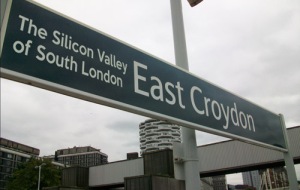
In early December, Prime Minister David Cameron and London Mayor Boris Johnson united to unveil plans to transform Shoreditch, East London, in a bid to turn it into a high tech hub for the UK.
In a sure sign that both politicians and journalists still like to think in what Nicholas Negroponte might call ‘Atoms not Bits’ (Bricks and mortar are still seen as more impressive than abstract and rather invisible interventions in the market) media headlines led with the proposed £50 million new building and “largest indoor civic space in europe” which will sprout from Old Street roundabout. Cameron announced that Microsoft will open a technology developer centre and there will be an incubator centre run by UCL with Cisco and DC Thompson to help new companies. It’s not clear the effect this will have on the low rent environment that was Shoreditch’s original attraction for many start-ups.
Although the government now prefers the title Tech City, Silicon Roundabout was the original vernacular used by its earliest denizens. The term seems to have been christened in July 2008 by Matt Biddulph, who was at the time CTO of Dopplr (the online service that lets travellers share future travel plans with friends, since swallowed by Nokia). Dopplr was one of the first 15 companies identified then as a cluster. The term was seized upon by Mark Prigg, Science and Technology Editor of The Evening Standard with the headline “Roundabout is London’s Answer to Silicon Valley”.
By January 2010, Wired magazine noted there were 85 start-up companies in the area, drawn by rents, hip nightlife and a legacy of existing tech and creative firms from the 80’s; Dopplr, Last.fm, Consolidated Independent, Tinker.it, TweetDeck, Berg, Trampoline Systems, AMEE, Skimbit, Fotango, weartical.com, Songkick, Techlightenment, Poke London, Kizoom, BrightLemon, Redmonk, Moo, LShift and Livemusic being the leading lights.
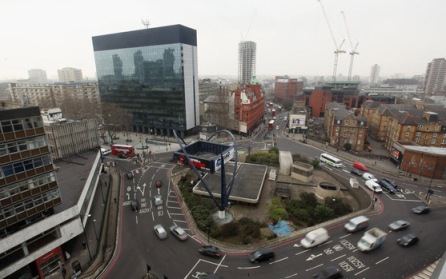
The undeveloped real estate: Old St Roundabout
By the time DEMOS had written the report “A Tale of Tech City: The future of inner east london’s digital economy” in June 2012, the area had gained both acreage and density with over 3,200 firms and over 48,000 jobs.
This makes it the biggest employer of all the UK ‘Silicons’: Silicon Glen (Dundee/Inverclyde) and Silicon Fen (Cambridge). There seems to be a contest on for Silicon Beach between Brighton and Bournemouth, which hasn’t yet caught the public imagination.
Why is it when we talk about clusters of high-tech companies and media agencies, it isn’t long before some comparison to Silicon Valley is made? No other Silicon suffixed cluster has been able to nestle within a capital city outside of Africa (Silicon Lagoon in Lagos, Silicon Cape in Cape Town and Silicon Savannah in Nairobi tell a story of central funding in Africa), so London’s cluster is quite unusual in this respect. Israel’s Silicon Wadi centres around Tel Aviv, (although it has since stretched to Jerusalem, however that may be due to the concentration of space in Israel, and also media agencies like Thomson Reuters and the BBC needing such a base). Less well known are Silicon Alley in New York, Silicon Dominion in Virginia and Silicon Forest in Portland, Oregon, to name just a few.
As AnnaLee Saxenian Dean and Professor in the School of Information at the University of California, Berkeley, – who has spent years studying the valley’s attributes – says “Simply having the ingredients of Silicon Valley doesn’t mean you have its regional dynamism. This notion that you can grow the next Silicon Valley by putting together a science park, venture capital and a university has been roundly disproven.”
So what makes Silicon Valley endure, and can we learn anything from it? The Santa Clara Valley (originally mostly walnut and apricot farms) seem to be as much about the culture engendered as the low rents and lock-ups of the time, and the ready supply of gifted students from Stanford and Berkeley.
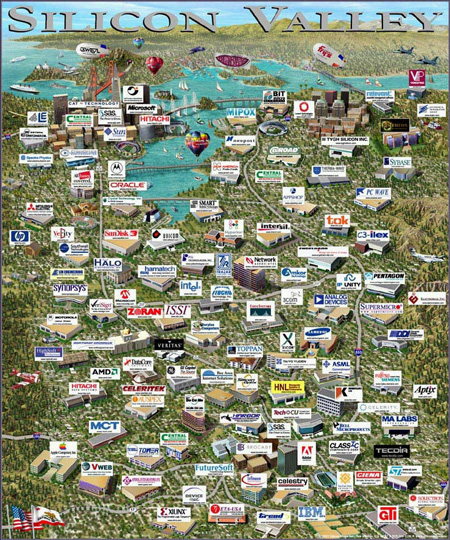
Wish you were here? This is what 225,300 high-tech jobs look like
AnnaLee Saxenian charts how what became Silicon Valley benefitted from the collapse of the Boston high-tech centre that had built up around Route 128 in the 70’s defined by six of the ten largest technology firms in the world (including DEC, Wang, Lotus, Raytheon, Sun Microsystems).
The towering monoliths of Route 128 operated in competitive secrecy. Former DEC (Digital Equipment Corporation) VP Gordon Bell remarked that DEC was “a large entity that operates as an island in the regional economy”. At one point DEC employed more than 120,000 people, which like it’s rival neighbours was constricted by an insular culture that was enforced by ‘non-compete clauses’ and non-disclosure agreements, and scientists who were dissuaded from publishing in acknowledged peer-reviewed journals.
Against this command and control backdrop, where these ‘island’ companies kept to themselves, there was an urban culture of openness and collaboration developing in California. Silicon Valley’s success and Route 128’s nadir was about two competing social and business cultures rather than the setting aside of business parks or tax incentives.
In “Imagine: How Creativity Works” Jonah Lehrer charts how the creativity of an urban area depends upon its ability to encourage the free-flow of information. Although both Boston and San Jose had a density of talent, the talent wasn’t able to interact or share within the Route 128 cluster.
In urban California, the start-ups were more informal and being smaller, had to share engineers and techies to get by as a necessity. Work was more project-based, with companies having short lifespans (the average tenure at a Silicon Valley company was less than two years). The café and bar culture promoted informal interaction and dense social networks loosened tongues. Whereas information flowed vertically in the towering walled fiefdoms of DEC, Lotus and Wang in Boston, it flowed horizontally with ease in California. Also non-compete clauses (a powerful weapon in the hands of the big Boston corporations) were almost never enforced in California, thus freeing out of work engineers and executives to quickly re-enter the job market and work for competitors.
Informal urban networks grew through bar and café culture- and the zeal for informal meeting places spread to loose groups like the now almost mythic Homebrew Computer Club, founded in a Menlo Park garage in 1975. It was a club for hobbyists, since there was not yet an established industry for this new creativity. Within a year nearly 750 people were members. As early member and doctor, engineer, and entrepreneur Bob Lash states “The excitement at homebrew was electric, and during the period of ’74 to ’76 I constructed a working 12-bit microprogrammed minicomputer using a 30-bit micro-control store entirely out of about 100 SSI/MSI TTL wire-wrapped chips, which (thanks to the understanding of my wife) I still have in the garage” Members built their own inexpensive machines from components to impress each other, and circuit diagrams and schematics were shared as freely as advice and support. Alliances were made; it was here that a Hewlett-Packard engineer called Steve Wozniak had shown his ground breaking twenty dollar microprocessor with 256k of memory that caught the attention of a young Steve Jobs. As interest grew, meetings moved to the Stanford University Physics department.
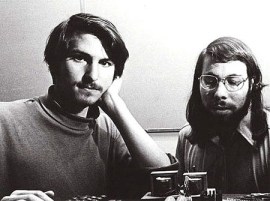
The two Steves
Through a culture of informality, unregulated curiosity, sprawling social networks and a lack of centralised policy Silicon Valley grew to spawn 225,300 high-tech jobs and the most billionaires in the United States per capita.
It’s clear that this culture was also present in Silicon Roundabout’s inception. Hoxton’s cafes, bars and clubs provide that informal network, where everyone knows everyone. In a 2008 article Alexandra Deschamps-Sonsino, of interactive consultancy tinker.it (the online store for Arduino products), said the area had developed a sense of community, adding: “We are based in a building with a courtyard in the middle and everyone around is doing really exciting things. Generally we all end up having coffee together and comparing what we are working on. I think a lot of deals have been done that way.” That was in 2008, but Alexandra is still in Shoreditch, as an interaction designer & entrepreneur at Designswarm. Matt Webb, co-founder of design consultancy Schulze and Webb, said “The networking possibilities are amazing. On our first day here we were having lunch in the park and we came across the guys from last.fm, who we are really keen to work with”.

Tech City and 3,200 firms
It’s this cultural narrative that politicians often miss in their desire to see high tech clusters mushroom in their own backyard. It’s a culture of serendipity and accidental meetings, a loose social network where unplanned alliances can transform companies.
In London we are seeing the rebranding of Silicon Roundabout into Tech City, led by the creation of the Tech City Investment Organisation (TCIO) as a branch of the government’s UK Trade & Investment (UKT&I) group. Erik van der Kleij, chief executive of the Tech City Investment Organisation outlines their mission “The digital sector is the only sector of the economy that is capable of giving us double digit growth. At government level, that is an area we’re very keen to help with and not mess up. We want to do the things at policy level to help growth happen” Plans involve merging Tech City with the vacant Olympic Park media centre further east in Stratford which has never had the social buzz of Shoreditch, but definitely has the post-Olympic cheap rents.
 In their 136 page “A Tale of Tech City: the future of inner East London’s digital economy” Demos’ Centre for London thinktank issues a caution; “There are fears that by concentrating its energy on the Olympic Park sites, which many see as the main reason for the government’s continued attention, the TCIO risks diminishing the energy of what is still a young cluster.” It also comments “our evidence also tells us that artificially generating clusters in mature industries – as digital content and ICT now are – is very difficult”.
Innovation and Growth is not an exact science. It may well be that the Tech City vision will be realised not by a 50 million pound civic centre and start up incubator complex as much as the ability to hold whatever todays version of the Homebrew Computer club may be, in some bar or café, where chance encounter and talent footfall might combine and connect.
Where next? But the culture needs to be right for Innovation, and that means social culture too.


 Lisa Harmon, a Senior artist and animator with Sony Computer Entertainment Europe, who has worked in the industry for ten years on titles such as TV Superstars, LittleBigPlanet (PSP version), Primal, 24: The Game and Heavenly Sword speaks for many when she says “I don’t think that a lack of women in this industry harms it, and anyway I don’t know of any women already in the industry that are bothered by it. During my time in games I can’t say that I’ve ever experienced any discrimination, but I do think the games industry is still seen as geeky and something you do as you’re growing up rather than as a career.”
 Finding a Unicorn


 The good news is that other methods of crowdfunding like selling “War Bonds” and merchandising has raised about 50,000 euros to date for Iron Sky, helping support the core team, and it has been stated that this fantastic looking project has 200,000 euros committed by crowd investors so far. For large productions it seems that crowdsourcing needs to be just one ingredient in the funding mix. It’s clear in a world of crowdfunding there will be winners and losers- and some media forms may suit better than others.
 At the time of writing “App of the week” on the Appbackr site is Boogie Monster by Monstrous with $11,765 raised in funds.Backing an app early gives you the opportunity to make a higher return, thus encouraging popular themes and genres, and therein may lie the achilles heel of crowdfunding, which is the notions of surprise, novelty and innovation.
 HaZ started his career in video games cinematics as an Artist and TD before moving into visual effects and compositing for Feature films, commercials and music promos. Over the years he has worked with clients such as MPC, Passion Pictures, Partizan, Glassworks, The Mill and other high profile studios in London. He has recently completed work at Jellyfish Pictures as VFX supervisor on BBC’s most ambitious full CG creature series – Planet Dinosaurs due to release in Autumn 2011, and is currently Visual Effects Supervisor at Prime Focus London.
 The Foundry provided Nuke which was the core VFX production tool of Fubar because the USP was to make a film completely in Nuke by creating a sandbox environment inside Nuke’s 3D compositing space”. Interestingly, a scan of donors reveal that several employees from the Foundry also felt excited enough by the project to slip in the odd donation.
 HaZ also thought creatively about how to make funding attractive- and proposed to “Feature your Cat or Dog in the Film as a character when you make a Pledge…if you have a cat or dog and would like it featured in the film as one of the marines, or additional characters then send over 3 – 5 images in several angles for it to be digitally placed into the animation. We will contact you if it’s selected to be in the film and of course your cat or dog gets a credit in the film too!”


 Over the last few years the acronym STEM has increasingly entered debates within the collective creative industries, and also at Creative Skillset.
 However, the bigger picture is that from a creative media industry perspective, the often unintentionally university faculty led and framed opposition between Art and Science has been increasingly problematic over recent years. In Computer Games for instance, what are needed are programmers who are creative and flexible, and artists who can apply their skills to strict technological constraints. The best way to teach many cutting edge skills is in a university system that can foster multidisciplinary teamworking skills, and that’s usually a university that has synergistic and co-operative faculties, rather than competing ones.
 Creating Prosperity declares that “there is often a false opposition established between ‘creative’ subjects on one hand, and STEM subjects on the other. At one level, this is understandable, as the policy priority on STEM has meant a recent emphasis on increasing student places in these subjects, with a concern that this will come at the expense of places elsewhere. The outcomes of Browne and the CSR make this increasingly likely. However, STEM skills are also needed in the creative economy, whether engineers in broadcasting or maths and physics skills in computer games development. This is consistently overlooked in current debates that seek to polarise STEM and creative disciplines….Indeed, creative skills are needed in all industries, including those supported by the STEM disciplines. This clearly challenges a narrow view of STEM as the sole route to economic growth”
 We need to articulate the notion of STEAM (or another snappy acronym), and fast. As Creating Prosperity recognises, this is what Skillset has been advising policymakers for a while through our regular Sector Skills Assessments, but maybe it’s time to package and communicate this concept in a neat, concise and friendly way for this new breed of discerning student who may gravitate towards cheaper and easily defined STEM courses, instead of understanding the notion of STEAM.
 As online technologies mature, animation skills have been seen to seep into many new niches like advertising, architectural visualisation, interactive media or games, to service the many new business that spring up in the wake of the web. Currently a new hybrid advertising and games sector may be opening up utilising locative technologies enabled by a new breed of smartphones, and this may eventually become another important important source of work for the animation industry- if the advertising industry is to be believed.
 Zynga games are free- if you want them to be. You can play as long as you like for nothing, but there are extras which will add to your enjoyment and sense of achievement. For instance you might pay for a virtual tractor to speed up your crops growth. 82 percent of Zynga’s customers pay nothing, but around 5 percent spend $1-5 in the game, and about the same amount spend $6-10. 3 percent of FarmVille users spend more than $20 a month. That’s the major way the company rakes in $1 million a day.
 The global market for video games is projected to grow at an annual rate of 10.6 percent over the coming years to reach $86.7 billion in 2014. UK businesses generated £2 billion in global sales and contributed £1 billion to GDP.


 Gamification has turned what many people consider a chore or find hard to get motivated about into a system of social bragging rights and a sense that you are achieving progress through virtual rewards, on a global scale. Recently over 800,000 runners logged on and signed up when Nike sponsored a 10K race simultaneously across 25 international cities. Over 1.8 million runners are currently using Nike+


 Seth Priebatsch was 20 when he set up

 It’s widely regarded that innovation is the cornerstone of new economic growth and success, for both the companies that innovate and the countries that tax them.


 Tony Wagner describes the
 Of course Wagner’s experience is of the American system, and it may well be our system is more adaptable and pliable, because we can all name good practice where all these qualities happen in isolation, but Wagner’s point is the system was not invented to accommodate these issues, which makes it painfully hard to innovate, and much harder than it should be. His seven survival skills are a useful measure and guide and take us beyond the impasse of just demanding that schools ‘Must Try Harder’. It seems to me that we need to also add one more item to Wagner’s list of ways to foster a new innovation culture in our young people, and that is to raise the status of the teacher, and to celebrate those motivated paragons who surmount the barriers and walls of the current system.
 There are certain strong ideas that we instinctively and rightly want to highlight and see nurtured in our creative industries.
 In the past
  HALOGENIC